[A szöveg csak angol nyelven érhető el] Year: 2026
Medium: TouchDesigner, machine vision, generative AI
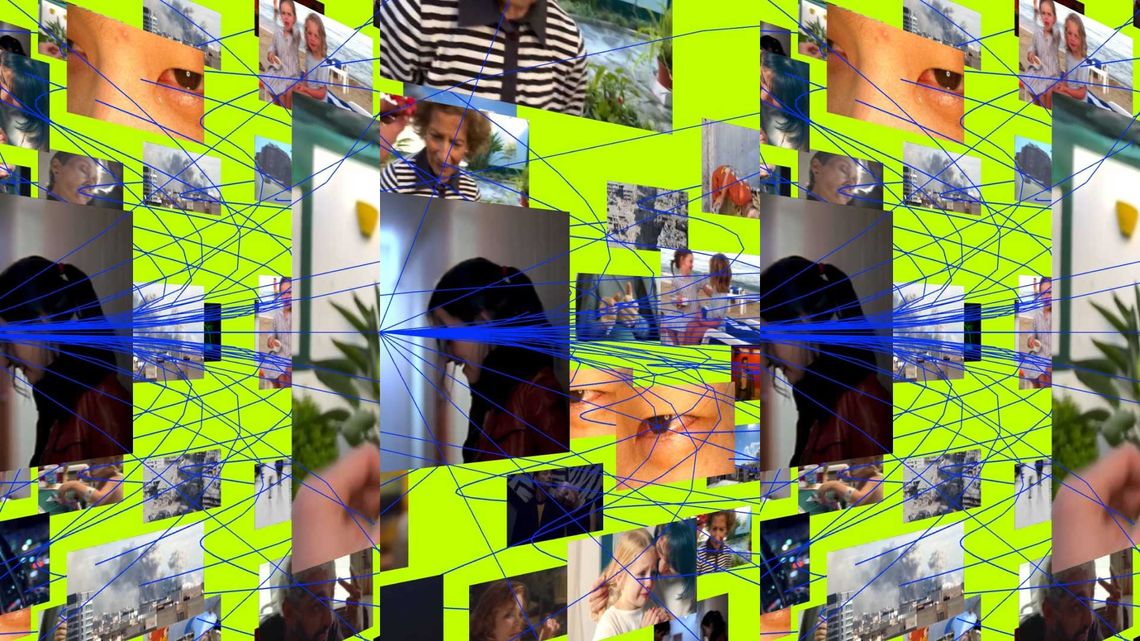
Tear Model is an immersive artwork that explores the possibility of artificial emotion through the language of computation. Combining generative visuals, machine vision, artificial intelligence and live audiovisual processing, the work stages an experiment in which an artificial entity is exposed to images associated with human grief, empathy and memory.
The entity does not see or experience these images as a human would. Each video is sampled into individual frames and processed through a chain of artificial perception. A machine-vision model first translates the visual input into language; a large language model then interprets this description through a predefined affective framework, estimating parameters such as emotion, valence, arousal, cognitive load, memorability and motivational response. The image is progressively transformed from visual input into language, and from language into emotional data.
These values become part of the audiovisual composition itself, informing the generative visual and sonic behaviour of the immersive environment. Artificial intelligence is therefore used not simply as an image-generating tool, but as a speculative emotional apparatus: a system attempting to construct a computational model of what it means to be affected. Rather than asking whether a machine can truly feel, Tear Model investigates how emotions can be observed, classified, measured and simulated.
Each visual input becomes a constellation of parameters, probabilities and scores, suggesting that emotional experience can be approached not only as something lived, but also as something modelled. Yet the experiment gradually turns its gaze back onto the audience. The artificial entity does not become tired of what it sees, scroll past it, or grow accustomed to an image simply because it has encountered it many times before. Human perception, by contrast, is shaped by repetition, context, narrative and habituation.
If an artificial intelligence can continuously recognise patterns of sadness, loss and suffering while humans increasingly overlook or become desensitised to them, what defines our humanity? Is being human a matter of feeling, of recognising emotion in others, or of choosing to respond to it?
Positioned between scientific speculation and poetic fiction, Tear Model does not attempt to prove that machines can experience emotions. Instead, it uses the possibility of artificial empathy to question our own. If emotions can be predicted, classified and simulated, what remains irreducibly human? And if a machine never learns to become indifferent, which one of us is performing empathy?