[A szöveg csak angol nyelven érhető el] As beeing powered by Corona, I had time to develop things in the time of the pandemic.
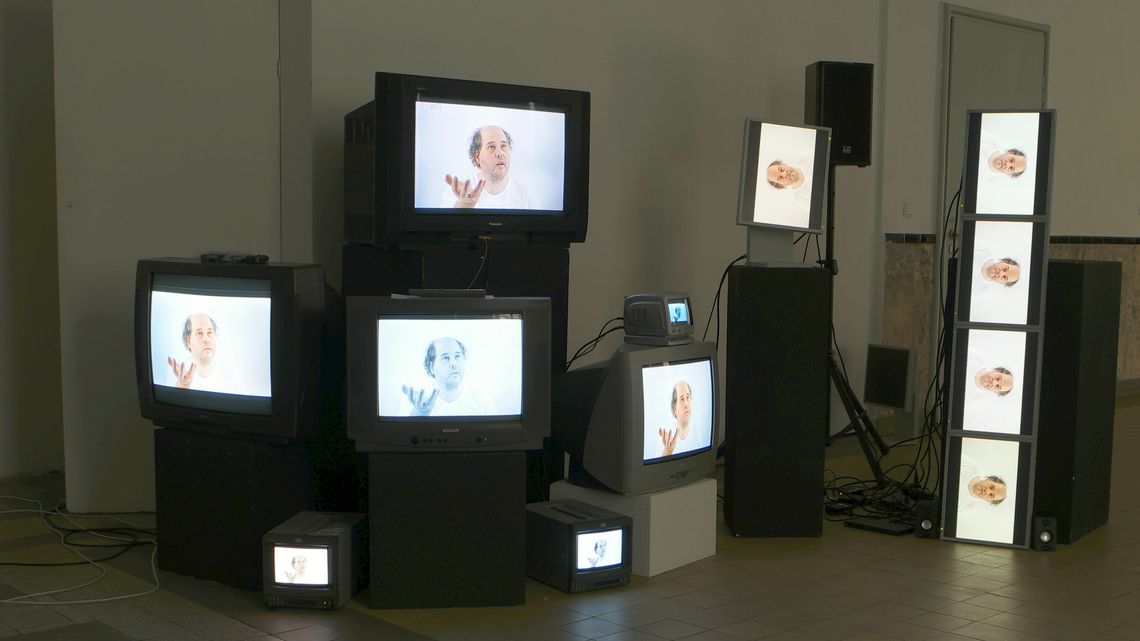
Spell Time Alpha is an interactive Videoinstallation with multi-AV output, that transforms words into video clips to spell them letter by letter. As it is a skeleton system, everything is scalable from input to output. If there is no interactivity, the many independent AV channels loose sync after a while and give the installation the impression of a babbling choir. The showed content will be locally extended all the time in a system to record the videoclips with fresh faces of the venue in a light box.
The face and setup you see in the picture is meant as demo content I made to give an idea of Spell Time Alpha's possibilities.
The advanced input options developed by now range from speech recognition with selected old analog phones, over handwritten text-recognition, throughout reading twitter messages by hashtag.
Customization for an exhibition topic is intended. Multiple types of locally available displays might be used also in the installation. It's flexible.
https://vimeo.com/512483210----
Technologies that have been used:
Linux, Windows, RouterOS, Raspberry Pi, vvvv, ffmpeg, mpv, Avahi/Bonjour, NFS, Asterisk, Kaldi, Twarc, Sane, Tesseract OCR, Socat, Oracle Virtualbox.
The parts of the Spell Time Alpha Installation are developed in diverse environments.
To drive the displays Rasperry Pis with Linux and the mpv player are used. The controller for it has been developed in vvvv on Windows. Likewise the recorder logic, which additionally uses ffmpeg to record the videos.
The recording box consist of a big lightbox to sit in, a footswitch for controlling, a HDMI camera with directional mic and a preview screen to show the output of vvvv.
All already developed input options run on Linux with the use of tools, bash-scripting and socat, as the storage server does also. The controller is hosted in a VM on the Linux machine too. The Players announce themselves on the network with Zeroconf technology and have no fixed adress.
To maintain mobility for everything laptops have been used.
The network to connect everything uses gigabit technology, several dumb switches and a router from Mikrotik.
All system components can be adapted and extended in terms of numbers and data throughput.